Personal style does not always begin in a store.
Sometimes it begins in a sibling’s closet.
On August 11, 2026, actress Madison Bailey, 29, told People that growing up as the youngest of seven siblings gave her an unusually open way to experiment with clothing. Bailey, known for playing Kiara Carrera in Outer Banks, said she wore pieces belonging to both her brothers and sisters while gradually figuring out what felt like her own style. Her comments arrived alongside Journeys’ 2026 back-to-school campaign, “Turn It Up,” which centers on experimentation, individuality, and rejecting pressure to fit into one prescribed image.
The story is useful because hand-me-downs are often discussed mainly as a way to save money. They can certainly do that, but borrowed and inherited clothing can offer something else: a low-pressure laboratory for personal style.
A jacket you would never purchase may reveal that you like oversized proportions. A sibling’s trousers may introduce you to a higher rise. A shirt in an unfamiliar color might work better than expected. Even clothes that fail can teach you something about fit, texture, silhouette, or the image you want to create.
The strongest personal style rarely comes from copying another person completely. It develops through repeated experiments, including experiments that cost nothing.
Madison Bailey Learned Style Through Other People’s Clothes
Bailey’s comments are especially relevant because she did not describe her siblings’ clothing as a fixed style template.
She described it as raw material.
In the August interview, Bailey said her older siblings were important influences and explained that she wore clothing from both her brother and sister while developing her own preferences. Rather than inheriting one specific look, she learned to choose among different visual possibilities. Her parents, she said, also gave the siblings substantial freedom over what they wore. The full Madison Bailey interview connects those experiences directly with experimentation and self-expression.
That distinction matters.
Copying says, “I want to dress like this person.”
Experimenting says, “I want to understand what part of this works for me.”
The second process is much more useful for building long-term style.
A borrowed leather jacket may teach you that you like structure but not black. A loose menswear shirt may reveal that you prefer volume on top when the trousers are more fitted. An older sibling’s colorful sneakers may show that you enjoy using shoes as the focal point of otherwise simple outfits.
Eventually, the source matters less than the information you gained.
Hand-Me-Downs Remove Some of the Pressure to Get Fashion “Right”
Buying new clothing can make experimentation feel expensive.
If you spend $150 on a pair of unusual trousers, there is pressure to make them work. You may keep wearing them even when the proportions never feel right because admitting the experiment failed makes the purchase feel wasteful.
Hand-me-downs change that psychology.
The garment already exists.
You can try it with several tops, wear it around the house, photograph it, layer it differently, or decide after two days that the style is completely wrong for you.
Nothing has gone wrong.
You simply learned something.
That lower cost of failure creates space for more adventurous decisions.
Someone who normally buys only black may try a burgundy sweater inherited from a sibling. Someone who has always worn skinny jeans might discover that an older pair of relaxed trousers creates a proportion they prefer. Someone who assumes tailored clothing feels too formal may discover that a borrowed blazer works when paired with casual denim and sneakers.
This is one reason shared clothing can help personal style develop faster than shopping exclusively within familiar categories.
Clothing Sharing Can Actually Affect Identity
The connection between borrowed clothes and identity is not only anecdotal.
Research published in 2026 by academics at the University of Birmingham examined the experiences of 40 people aged 19 to 45 who regularly borrowed or lent clothing. Researchers Kelly Wang, Caroline Moraes, Isabelle Szmigin, and Doğa Istanbulluoglu found that shared garments could serve social, practical, and expressive functions.
Participants described borrowing clothes not only for specific occasions but also to experiment with colors and styles they might never have purchased themselves. The researchers described one aspect of the process as “self-blending,” in which clothing associated with another person can temporarily become part of how the wearer explores or expresses identity. The University of Birmingham clothing-sharing research also found that shared clothing could strengthen emotional connections among friends and family.
That does not mean wearing your sister’s coat changes who you are.
It suggests that clothes can create a safe way to test a version of yourself before fully adopting it.
That is exactly how personal style often develops.
The Best Hand-Me-Down Is Not Necessarily the Best Garment
When evaluating inherited clothing, separate emotional value from practical value.
A sweatshirt belonging to an older sibling may have enormous sentimental importance even if you rarely wear it.
Another item may have no emotional significance but fit perfectly into your everyday wardrobe.
Both are valid.
The mistake is assuming every hand-me-down needs to become a permanent part of your style simply because someone important owned it.
Ask what the garment actually contributes.
Does the color work with clothing you already own?
Does the silhouette feel good?
Can you create at least two or three outfits around it?
Would tailoring make it useful?
Does it suit your real lifestyle?
If the answer is no, keeping it as a memory may make more sense than forcing it into regular rotation.
Personal style becomes clearer when sentimental value and styling value are allowed to be different things.
Borrowing Lets You Test Silhouettes Before Buying Them
Silhouette is one of the hardest elements of style to understand from product photographs.
A wide-leg trouser can look dramatic on a model and surprisingly natural on you.
An oversized blazer may seem too large on the hanger but balance your preferred jeans perfectly.
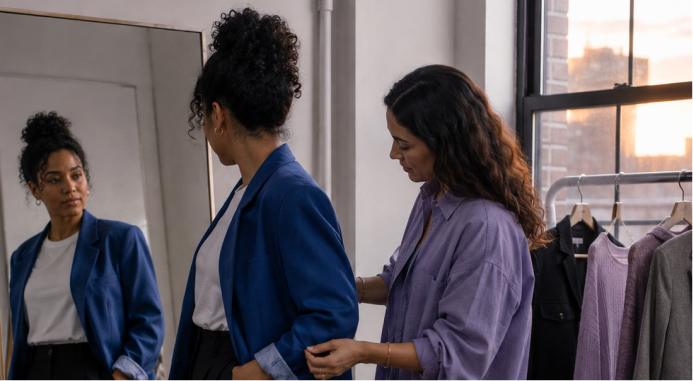
A cropped jacket may appear difficult until you try it with higher-waisted trousers.
Borrowing is one of the cheapest ways to test those relationships.
Instead of asking whether the garment looks fashionable in isolation, look at the proportion it creates when worn.
Check the shoulder line.
Look at where the hem ends.
Notice the relationship between the top and waistband.
Examine how much fabric appears above and below the natural waist.
Then take a photograph from several feet away rather than relying only on a close mirror view.
Photography can reveal proportion more clearly because it compresses the outfit into one visual composition.
The goal is not to judge your body.
It is to judge how the garments relate to one another.
For more appearance-focused ideas, Finest Image covers personal presentation through photography, clothing, visual image, and style decisions.
Try the Borrowed Piece With Your Own Clothes
A hand-me-down becomes useful when it stops looking like someone else’s garment.
The easiest way to make that happen is to style it only with things you already consider yours.
If your sister gives you a vintage denim jacket, resist the urge to recreate the outfit she used to wear with it.
Try it with your trousers.
Your shoes.
Your jewelry.
Your usual colors.
Your preferred layering.
That shift matters because personal style emerges through combinations.
The same jacket can appear completely different over a floral dress, with wide black trousers, with athletic clothing, or layered beneath a wool coat.
By changing the surrounding pieces, you discover whether you genuinely like the garment or merely like the person associated with it.
One Borrowed Item Can Break a Repetitive Style Habit
Most wardrobes develop patterns.
Those patterns are useful because they make dressing easier, but they can also become restrictive.
Someone may repeatedly buy the same fitted black top because they know how to style it.
Another person might own five nearly identical straight-leg jeans because each new purchase feels safe.
A hand-me-down can interrupt that cycle without requiring a major financial commitment.
Suppose your normal outfit is:
dark jeans, fitted shirt, white sneakers.
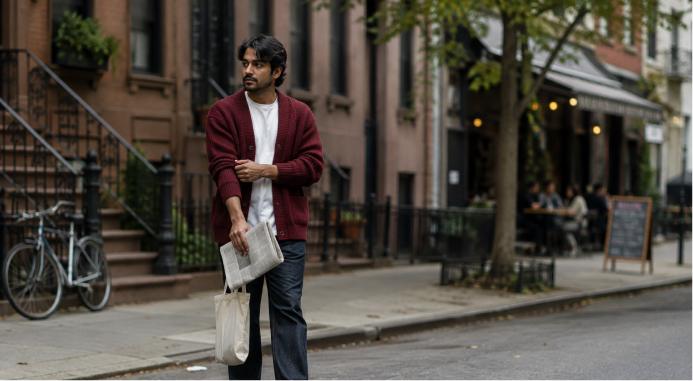
A sibling gives you an oversized rust-colored cardigan.
Suddenly the proportions change.
Maybe you roll the sleeves.
Maybe you add loafers.
Maybe you decide the dark jeans now feel too visually heavy and try lighter trousers.
One unfamiliar item forces the rest of the wardrobe into a new conversation.
Even if you eventually stop wearing the cardigan, the experiment may permanently change how you think about proportion or color.
Journeys Is Building Its 2026 Campaign Around the Same Idea
Bailey’s comments are especially well matched to the campaign she is promoting.
Journeys launched its 2026 “Life on Loud” creative platform in July around the idea of resisting uniformity and using style as a form of personal expression. The company worked with artist and director Max Siedentopf on the campaign film, while music producer Star Slinger created its electronic soundtrack.
Journeys describes the campaign as encouraging consumers to show up as themselves rather than simply follow trends. Its current campaign material specifically frames personal style as something that can evolve as people experiment with different versions of themselves. The official Journeys Life on Loud campaign provides the brand’s own explanation of that strategy.
Of course, Journeys is a retailer and ultimately benefits when people purchase footwear.
The broader idea still has value beyond the campaign.
You do not have to buy something new every time you want to experiment.
Sometimes the best way to try another version of your style is to start with clothes already circulating among people you know.
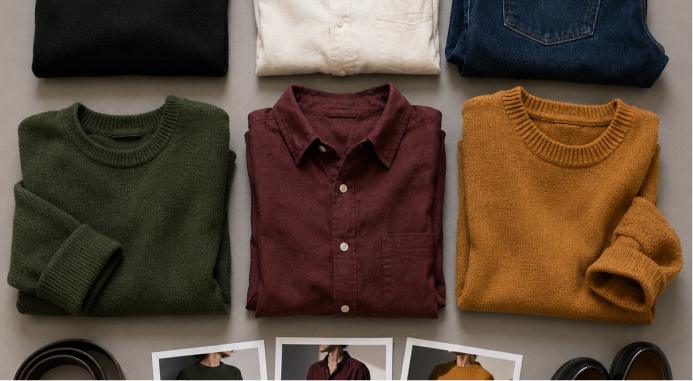
Hand-Me-Downs Can Help You Discover Your Color Palette
Many people believe they dislike a color when what they actually dislike is one particular version of it.
You may think green does not suit you because the only green sweater you owned was a cold mint tone.
Then someone gives you a deep olive jacket and it becomes one of your most worn pieces.
Hand-me-downs expose you to colors you may never have selected from a retail rack.
Pay attention when this happens.
Which colors repeatedly make you want to wear the garment?
Which ones coordinate easily with your existing clothes?
Which shades photograph well?
Which ones make your usual neutrals more interesting?
Over time, these observations can create a personal palette.
That does not mean every item must match.
It simply means you understand which colors are easiest for you to combine and which ones require more deliberate styling.
Do Not Assume the Original Gender Category Matters
Clothes handed down between siblings also provide a natural way to ignore some of retail fashion’s traditional category boundaries.
Bailey specifically described wearing clothing from both her brothers and sisters.
That can expose someone to different cuts, proportions, fabric weights, and styling conventions.
A menswear shirt may provide a better oversized silhouette.
A women’s cardigan may offer the exact color or texture someone prefers.
A sibling’s unisex sneakers may change the balance of an outfit more effectively than a shoe bought from the section you normally shop.
What matters is the garment.
Does it fit the way you want?
Can it be styled comfortably?
Does it work with your image?
The label sewn inside is often far less important than those questions.
Alteration Can Turn an Almost-Right Piece Into Your Piece
Hand-me-downs rarely arrive in precisely the size or proportion you would choose yourself.
That does not automatically make them unusable.
A tailor can shorten sleeves, adjust trouser length, reduce a waistband, reshape a jacket slightly, or change buttons.
Small changes can transform how a garment feels.
The decision should depend on the quality and usefulness of the piece.
Alteration may make sense for a well-made wool coat that could be worn for years.
It may make less sense for a worn-out T-shirt with sentimental rather than practical value.
Before tailoring, pin or fold the garment temporarily and photograph the proposed change.
You may discover that what looked like a fit problem is actually a styling problem—or vice versa.
Shared Clothing Should Still Respect Boundaries
Not every family treats clothing as communal property.
A garment being in the same house does not mean it can be borrowed without permission.
The University of Birmingham research found that trust was one of the social dimensions of clothing sharing. Participants described lending garments as an activity shaped by relationships and expectations about care.
That sounds obvious, but it is part of why informal wardrobe sharing works differently from ordinary shopping.
Ask before borrowing.
Return clothing clean and in the agreed condition.
Be especially careful with delicate, expensive, sentimental, or difficult-to-replace pieces.
Shared fashion should strengthen relationships rather than create conflicts over missing jackets.
Personal Style Becomes Stronger When You Know Why You Like Something
The final goal is not to become better at wearing other people’s clothes.
It is to become better at recognizing your own preferences.
When a hand-me-down works particularly well, ask why.
Maybe it introduced you to a silhouette.
Maybe you discovered that you like substantial fabrics.
Maybe the color connects your wardrobe better than expected.
Maybe the garment has a lived-in softness that new clothes often lack.
Maybe it reminds you of someone.
Maybe you simply feel more like yourself wearing it.
The explanation matters because it gives you information for future purchases.
Instead of thinking, “I need another jacket like my brother’s,” you can become more precise:
“I like short structured jackets with wider shoulders.”
That is personal style.
A Stronger Style Often Comes From Experimentation, Not Shopping
Madison Bailey’s hand-me-down story works because it describes personal style as a process rather than a finished image.
She borrowed.
She mixed clothing from different siblings.
She tried different looks.
Eventually, the result became hers.
Research on informal clothing sharing suggests that this kind of experimentation can be social, practical, and expressive at the same time. The garment carries some history from its previous wearer, but the new wearer changes that history by placing it into different combinations and contexts.
That makes hand-me-downs unusually useful tools for developing style.
They reduce the cost of experimentation.
They introduce unexpected colors and silhouettes.
They loosen the assumption that your wardrobe has to come entirely from one department, one trend, or one aesthetic.
And because someone else chose the garment first, they occasionally push you toward something you never would have selected yourself.
The strongest personal style is rarely created by buying an entirely new identity.
It is built slowly from noticing what works, discarding what does not, repeating the combinations that feel natural, and remaining curious enough to try something unfamiliar.
Sometimes the piece that teaches you the most has already been worn by someone else.