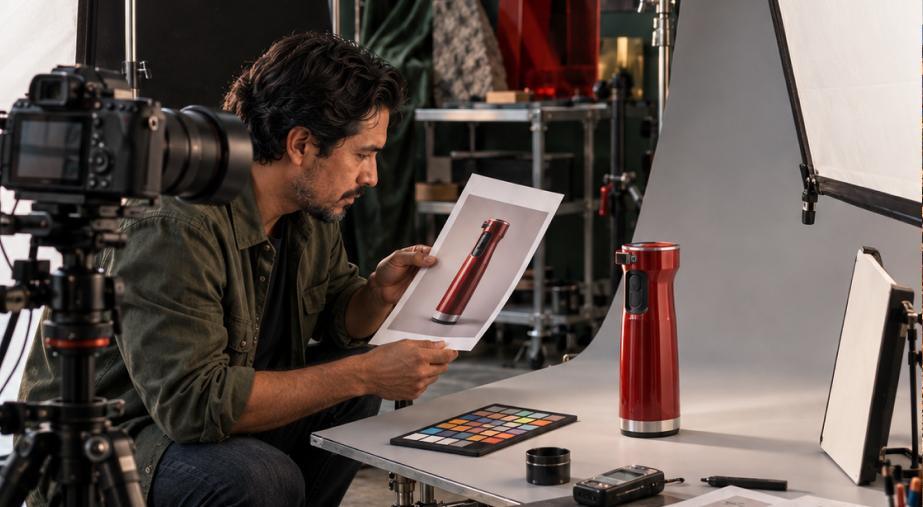
A product photograph used to arrive relatively late in the branding process.
A business established its name, logo, typography, colors, packaging and visual direction. The product was then photographed according to that identity.
Generative AI is beginning to reverse that sequence.
On September 2, 2026, Adobe updated its Firefly documentation with a workflow showing how its Firefly AI Assistant beta can begin with raw product photographs and move through retouching, brand-identity development, packaging mockups and social-media video. The workflow effectively turns existing product imagery into creative material for building a much larger visual system.
That raises an intriguing question for photographers, designers and small-business owners: could a single product photo become the starting point for an entire brand identity?
Technically, increasingly yes.
Strategically, the answer is more complicated.
A photograph can reveal an extraordinary amount about an object—color, material, shape, texture, proportion and potentially its intended environment. AI tools can extrapolate those visual characteristics into colors, graphics, backgrounds and campaign assets.
But a photograph cannot independently know why a company exists, who should buy its products or what the business wants to represent.
The distinction between those two capabilities may become increasingly important as branding and photography converge.
Adobe Is Turning Product Photography Into A Starting Point
Adobe’s current Firefly workflow makes the change unusually visible.
According to Adobe’s Firefly brand-building workflow, users can upload product photographs and work conversationally with the AI Assistant rather than manually moving through every individual creative application.
Adobe organizes the process into four broad stages: retouching product photography, developing a brand identity, creating packaging mockups and producing social-media video.
The starting requirements are surprisingly modest. Adobe says users need product photographs in JPG or PNG format along with a brand name and a general aesthetic direction.
It also recommends providing photographs from multiple angles and contexts because those references can improve recommendations for adjustments.
That last detail matters.
AI does not suddenly understand a product because it has seen one photograph.
Every additional accurate view supplies information.
A front photograph explains one surface. A three-quarter view reveals depth. A close-up communicates material. A photograph showing the object being used supplies scale and context.
The better the visual evidence, the more useful the product can become as a foundation for subsequent creative decisions.
A Product Already Contains Visual Information
Imagine an independent company preparing to launch a ceramic coffee maker.
Before anyone chooses a typeface or designs packaging, the physical object already communicates something visually.
Perhaps its body is matte terracotta.
Its handle is dark walnut.
Its geometry is rounded rather than angular.
Its controls are deliberately minimal.
Its surface is tactile rather than glossy.
Those characteristics can inspire a visual identity.
Terracotta could influence the palette. Rounded geometry might inform graphic shapes. Walnut could introduce a secondary neutral. The restrained physical controls might suggest uncluttered layouts.
None of those decisions needs to involve copying the literal shape of the product into a logo.
Instead, designers can extract visual principles.
This is where product photography becomes especially useful. A well-made photograph translates a three-dimensional object into the same two-dimensional visual environment in which advertisements, websites, packaging graphics and social content will eventually operate.
The photograph becomes an interface between industrial design and graphic identity.

But One Photograph Does Not Contain A Brand Strategy
The danger is assuming that because AI can generate a coherent visual package from an image, it has discovered the correct identity.
It has not.
Return to the fictional coffee maker.
The same terracotta appliance could belong to a premium design company selling $500 kitchen products, a sustainable direct-to-consumer startup, an affordable mass-market home brand or a company inspired by traditional craft.
The pixels alone cannot resolve that distinction.
They do not contain the company’s history.
They do not identify its customers.
They do not reveal its price position, competitive landscape, manufacturing philosophy or business objectives.
A photograph can answer:
What does this product look like?
Brand strategy needs to answer:
What should this product mean to the people we want to reach?
Those questions overlap, but they are not interchangeable.
Generative tools can accelerate the translation of strategic decisions into imagery. They should not be mistaken for evidence that strategy is unnecessary. Read more: Why Every Brand Needs Photography Guidelines, Not Just Logo Guidelines.
Product Photography Becomes More Important, Not Less
It might seem that AI capable of generating brand assets would reduce the importance of the original photograph.
The opposite may happen.
When a source image becomes the foundation for dozens of downstream assets, errors in that source can propagate.
Suppose the product’s real color is muted sage green, but the source photograph has an incorrect white balance that makes it turquoise.
If subsequent creative decisions are inspired by that photograph, the error is no longer confined to one picture. It can influence generated backgrounds, color palettes, packaging concepts and promotional graphics.
The same applies to shape and material.
An excessively reflective photograph could make matte plastic appear glossy.
Aggressive perspective could distort product proportions.
Heavy retouching could remove texture that is central to the object’s physical character.
This makes accurate product photography more strategically valuable.
The original photograph is no longer necessarily just another marketing asset.
It can become reference data.
The Best Master Image Is Not Necessarily The Most Dramatic One
Photographers creating foundational product imagery may therefore need to distinguish between a reference photograph and a campaign photograph.
A campaign photograph can be expressive.
It might use dramatic shadows, colored light, unusual perspective, shallow depth of field or environmental props.
Those decisions can make an advertisement memorable.
They can also obscure information.
A reference image has a different job.
It should communicate the product’s actual proportions, important materials, characteristic colors and distinguishing details as clearly as possible.
That generally means controlled lighting, accurate color, sensible perspective and enough depth of field to understand the object.
The most visually exciting image in a shoot may consequently be the wrong photograph to use as the basis for broader brand development.
A useful workflow could preserve both.
Create technically reliable master photographs first.
Then create more interpretive campaign photography once the visual identity has direction.
One Product Photo Can Generate Many Contexts
Once an accurate master exists, the possibilities expand rapidly.
The same product might need to appear on an ecommerce product page, homepage hero, vertical social advertisement, email banner, marketplace listing, seasonal campaign and short promotional video.
Historically, creating all those contexts could require several shoots or substantial compositing.
AI-assisted workflows make variations much easier.
Adobe’s recent work illustrates how quickly this area is developing. On August 28, 2026, Adobe published a Firefly tutorial by creative professional Kaleb Gonyea focused specifically on producing images and videos that feel like a cohesive set inside a unified generation-and-editing environment.
The important word is not generate.
It is cohesive.
Producing ten images is easy if those ten images have no relationship with one another.
Branding requires the opposite: variety without losing identity.
Consistency Requires More Than Repeating The Product
Putting the same product in every image does not automatically make a campaign coherent.
Imagine five advertisements featuring exactly the same bottle.
One has pastel studio lighting.
Another uses hard black-and-white flash.
The third places the bottle in a futuristic metallic room.
The fourth shows it on a rustic kitchen table.
The fifth surrounds it with neon graphics.
Product recognition remains consistent, but the visual identity does not.
A brand needs rules governing the environment surrounding the product.
Those rules can include lighting direction, contrast, camera height, lens perspective, background complexity, shadow treatment, saturation, negative space and the relationship between the object and people.
That is why the product photograph should be treated as a seed rather than a finished brand system.
It provides visual information.
Brand guidelines determine how that information should grow.
Approved Images Are Becoming Part Of Brand Infrastructure
A related Adobe development makes the broader direction even clearer.
On September 1, 2026, Adobe published new guidance on training custom AI models with existing creative assets. Adobe argues that approved campaign libraries contain information that conventional written guidelines cannot always communicate completely.
A style guide might specify colors and typography.
Actual campaign photography demonstrates how those rules interact with framing, lighting, negative space, subject placement, composition and hierarchy.
Adobe’s custom-model guidance recommends treating approved marketing imagery not merely as an archive but as a source of visual examples that can help custom models produce material closer to established brand standards.
That changes the strategic value of a company’s image library.
Yesterday’s campaigns are no longer necessarily dead files stored on a server.
They can become examples used to define tomorrow’s visual output.
Bad Photography Can Teach The Wrong Brand
That possibility creates a new problem.
An image archive contains history, but history is not always the same thing as identity.
Companies change.
Photography improves.
Audiences shift.
Campaigns fail.
Creative directors come and go.
If a company indiscriminately uses years of old assets as references, an AI system may encounter conflicting visual signals.
Adobe makes a similar point in its September guidance: training or configuring models with imagery from too narrow a context can limit how well the resulting visual identity adapts to different channels. Social imagery, for example, may communicate differently from material created for more formal formats.
Human curation therefore becomes essential.
Brands need to decide which images represent where they are going, not merely which images happen to exist.
This is another reason photography guidelines matter.
They provide criteria for separating an approved visual language from an accidental historical archive.
The Product Must Remain The Product
Generative workflows also create a particular risk for physical goods.
A lifestyle background can change dramatically without changing what is being sold.
The product itself often cannot.
If an AI-generated campaign alters the number of buttons on an appliance, changes the stitching on a handbag, modifies the opening of a bottle or invents a different surface texture, the image may cease to represent the real object accurately.
For ecommerce, that distinction is especially important.
Creative variation should happen primarily around the product unless an alteration is intentional, approved and clearly appropriate for the context.
Brands adopting these workflows therefore need product-integrity rules alongside traditional image guidelines.
The question is no longer merely, “Does this image look good?”
Teams need to ask, “Is the product still accurate?”

Provenance Matters As Images Become Easier To Transform
The easier it becomes to turn one photograph into many assets, the harder it can become to remember where each variation originated.
Adobe updated its Experience Manager documentation on September 1, 2026 to emphasize Content Credentials as a mechanism for carrying information about an asset’s origin and editing history through supported workflows.
The system can expose information including when credentials were issued, which application or AI tool made changes and who issued the credential.
That does not determine whether an image is aesthetically appropriate or factually truthful.
It addresses a different problem: history.
For brands working with original photography, retouching, generative backgrounds and AI-created variations, maintaining that history can become increasingly useful.
A team may eventually need to distinguish the original product photograph from a retouched master, a generated lifestyle variation and a compressed social-media derivative.
Visual production is becoming faster.
Asset governance has to keep up.
Small Brands Gain Power And Responsibility
These tools could have an especially large effect on small businesses.
A large company can commission photographers, designers, retouchers, art directors, packaging specialists and production agencies.
A small product company may have one founder and a freelance photographer.
Being able to start with strong product photography and rapidly explore packaging, color, advertising and social concepts lowers the cost of experimentation.
That can be valuable.
But cheaper experimentation should not be confused with automatic expertise.
Someone still needs to recognize poor typography.
Someone needs to notice when a generated package is impractical.
Someone must decide whether a photograph represents the product accurately.
Someone has to determine whether a color belongs to the brand or simply looks fashionable.
And someone has to reject an attractive image that tells the wrong story.
AI increases the number of possibilities.
It does not eliminate the need to choose among them.
The Photographer’s Role May Expand
This shift also creates an interesting opportunity for commercial photographers.
The photographer may increasingly need to think beyond producing the final hero shot.
A modern product shoot can become the beginning of a larger asset system.
That means photographing useful angles, preserving accurate color, documenting materials, creating clean master files and understanding which characteristics of the object should remain invariant across future transformations.
Commercial photographers who understand branding may become more valuable because they can create images designed for both immediate publication and downstream adaptation.
The camera remains responsible for documenting the physical object.
What happens after capture is expanding.
Start With The Product, Then Ask Better Questions
A single product photograph can now initiate a remarkable amount of creative work.
It can inspire colors.
It can suggest shapes.
It can influence packaging.
It can become the source for lifestyle environments, advertising variations and video concepts.
It may even contribute to the reference library used to teach future AI systems how a brand should look.
But that does not mean a photograph contains a complete brand waiting to be extracted.
The most useful approach is to treat the image as evidence.
What colors are genuinely characteristic of the product?
Which materials deserve emphasis?
Which shapes are distinctive?
What photographic treatment communicates those characteristics accurately?
Which of those visual qualities support the company’s intended position?
And which are merely incidental features of one photograph?
AI can increasingly move from a product photo toward an entire visual system.
The difficult part remains deciding which visual system is worth building.
That decision still belongs to people.