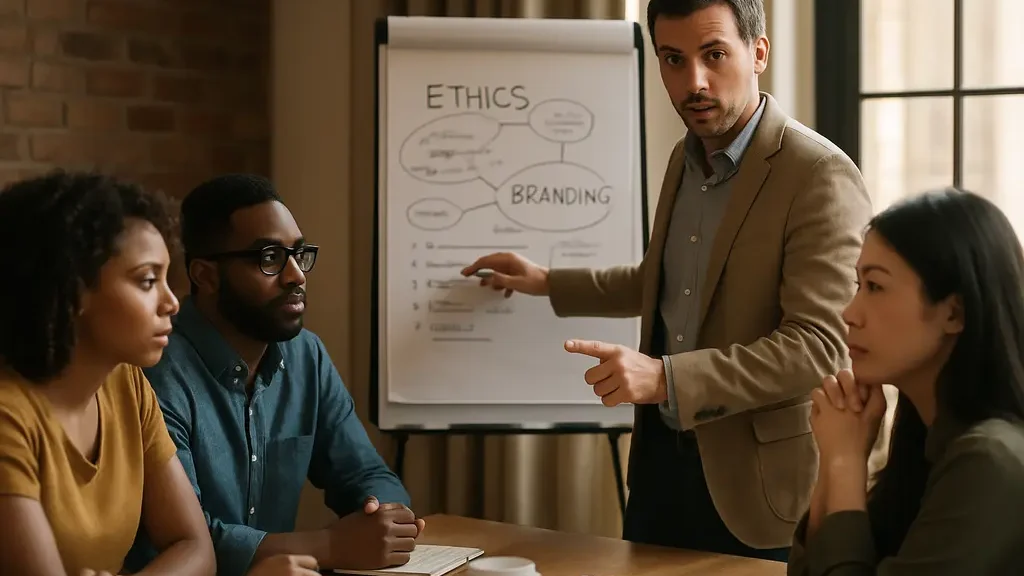
ANA ethics training gives marketers a practical reason to slow down before a campaign goes live. For visual brand work, that pause matters. A claim, a model choice, a gesture, a product image, or a social caption can shape how an organization is read by customers, employees, partners, and regulators.
The ANA launched its Ethics Code of Marketing Best Practices on July 17, 2024, describing a framework that covers areas including AI, privacy, advertising to children, bias, and inclusion, according to the ANA ethics framework announcement. The research notes for this article state that on September 1, 2026, the ANA introduced a 90-minute ethical marketing training course and an Ethics Champions program, alongside updated practical guidance for daily marketing decisions.
Because today is October 13, 2026, the September 24, 2026 Town Hall referenced in the research has already taken place. It should be treated as a past engagement point for marketers, not as an event still to attend.
What ANA ethics training Means For Brand Images
ANA ethics training and Daily Visual Choices
For brand teams, ANA ethics training is useful because ethical risk often appears in ordinary creative decisions. A campaign photograph might imply a product result that the copy cannot support. A stock image might show diversity in a superficial way that does not match the audience or the service. A confident pose might suggest expertise, authority, or certainty that the brand has not earned.
As a visual communication specialist, I look at marketing ethics through the full presentation: image, posture, styling, cropping, caption, claim, audience, and placement. The ethical question is not only, “Is this legal?” It is also, “Would a reasonable person understand this message in the way we intend?”
The research notes identify six ANA Ethics Code areas: advertising and marketing offers, advertising to specific audiences, inclusive marketing, data privacy, regulated products, and digital innovation. Those categories are a useful checklist for reviewing both words and visuals before publication.
Body Language Sends Claims Too
Body language can make a marketing message feel stronger than the headline. A crossed-arm expert standing over a customer can signal authority. A relaxed founder in a workshop can signal accessibility. A group image can suggest inclusion, teamwork, or community. None of those signals is automatically wrong, but each should match the reality of the product, service, or organization.
For example, if a professional services brand uses portraits with severe lighting, rigid posture, and distant eye contact, the visual story may communicate control more than care. If the same brand promises supportive guidance, the image style may work against the message. Ethics enters the picture because audiences respond to the total impression, not only to the written claim.
Build A Practical Ethics Review Before Campaign Approval
Check Claims Against The Image
A good ethics review should pair every strong image with the claim it supports. If a before-and-after style image appears in a health, beauty, coaching, or business context, ask whether the implied result is substantiated. If an image shows a person looking relieved after using a service, ask whether the copy clearly explains limits, conditions, and normal variation.
Use ANA ethics training as a prompt to create a short visual claim review. The goal is not to drain creativity from a campaign. It is to prevent visuals from saying more than the organization can fairly defend.
- Does the image imply a result, guarantee, status, discount, or level of expertise?
- Is the claim supported in the body copy or offer terms?
- Would the message still be clear if the image appeared without the headline?
- Are limitations, eligibility rules, or material conditions easy to see?
- Does the image respect the audience being represented?
Watch For Pressure Cues
The research notes state that the ANA guidance addresses truthful messaging, fair offers, and prohibitions on tactics such as hidden fees, forced continuity, and misleading urgency. Those issues are usually discussed as copywriting or user-experience problems, but they also show up visually.
A countdown graphic, a distressed facial expression, a crowded checkout design, or a bright warning-style badge can create pressure. Sometimes urgency is accurate, such as a genuine deadline. Sometimes the image exaggerates scarcity or anxiety. Ethical review should ask whether the visual pressure matches the real terms of the offer.
Inclusive Marketing Starts Before Image Selection
Representation Should Be Specific, Not Decorative
The research notes say the ANA Ethics Code prohibits unfair bias, negative stereotypes, and denigrating content, and calls for respectful, accurate portrayals across categories including gender, race, ethnicity, ability, religion, sexual orientation, socioeconomics, body type, and age. In practical terms, inclusion should not begin with a last-minute stock photo search.
Start by asking who the campaign is for, who is affected by it, and who has reviewed it. Then choose images that fit the message, context, and audience. A brand does not need to represent every group in every asset. It does need to avoid using people as visual decoration without care for accuracy, dignity, or relevance.
For a deeper image-focused process, this related article on ethical image selection outlines consent checks, purpose, inclusion review, and brand fit.
Clothing And Styling Shape Professional Narratives
Clothing choices can change how professional credibility is read. A lab coat, blazer, uniform, apron, headset, or casual founder outfit carries meaning. In ethical marketing, styling should help the audience understand the role being shown. It should not create a false sense of certification, medical authority, financial expertise, or official endorsement.
For individual branding, this is especially relevant. A consultant’s portrait in formal suiting may signal structure and seniority. A creative director in workwear may signal hands-on production. A nonprofit leader photographed in the field may signal proximity to the work. The key is alignment: clothing should support the professional narrative without overstating credentials or outcomes.
Responsible AI Needs Human Visual Judgment

AI Images Still Carry Brand Responsibility
The research notes state that ANA guidance covers responsible AI use, including transparency about AI-generated content, risk assessment before use, bias monitoring, and human oversight for sensitive use cases. Those points are especially relevant to synthetic portraits, product mockups, lifestyle scenes, and audience segmentation visuals.
AI-generated images can look polished while still creating ethical problems. They may depict unrealistic bodies, invented product performance, culturally confused settings, or people who appear to endorse a brand without being real. Human review should ask whether the asset could mislead viewers about who participated, what happened, or what the product can do.
Ethics education has been studied across professional and scientific settings; a meta-analytic review examined whether ethics training programs are improving in past and present instruction, as described in this ethics instruction review. For marketing teams, the practical lesson is to convert principles into repeated review habits rather than treating ethics as a one-time module.
Document The Decision
Documentation does not need to be burdensome. A short note can record whether an image is AI-generated, whether releases or licenses are in place, what claim the image supports, and who approved the risk review. This creates a shared memory for the team and helps future reviewers understand why a choice was made.
Teams that publish internal standards may also benefit from plain-language editorial examples from related publishing resources such as Interline Publishing, especially when translating policy language into staff-facing guidance. Visit Interline Publishing for more resources.
Turn Ethics Into A Creative Workflow
Make The Review Early Enough To Matter
The most useful ethics review happens before the campaign is fully built. If concerns arise after photography, editing, media buying, and stakeholder approval, teams may feel pressure to accept weak assets because time is short. Early review gives creative teams room to adjust casting, framing, copy, offer terms, or disclosure placement.
A practical workflow can include three checkpoints: concept review, asset review, and final publication review. Concept review asks whether the idea is fair. Asset review asks whether the images, gestures, styling, and claims match. Final publication review asks whether the landing page, disclosure, checkout flow, and targeting are consistent with the campaign promise.
Give Creative Teams Clear Boundaries
Creative professionals work better with clear standards than vague warnings. Instead of saying, “Do not be misleading,” define what misleading could look like in your category. For a recruitment campaign, it could be images that imply benefits or working conditions not reflected in the job posting. For a directory, it could be ranking language without disclosed criteria. For a professional brand, it could be portraits or captions that imply credentials not held.
That clarity supports better creative work. A photographer can compose a stronger portrait when they know the professional narrative. A designer can build a fairer offer page when the discount terms are settled. A copywriter can write more clearly when limitations are not hidden at the end of the process.
ANA ethics training and Brand Trust
The new ANA program is best understood as a prompt for practical discipline. It does not remove the need for legal review, category-specific compliance, or human judgment. It does give marketing teams a shared vocabulary for claims, privacy, inclusion, AI, and audience responsibility.
For visual branding, the most useful step is to treat images as statements. A facial expression can promise ease. A pose can imply authority. A wardrobe choice can suggest professional standing. A setting can imply scale, access, or community connection. Ethical marketing asks teams to check whether those impressions are fair.
Brands that make this review routine are better positioned to create campaigns that are clear, respectful, and easier to defend. That is the practical value of ethics work: not dramatic slogans, but better decisions before the audience ever sees the campaign.