Your LinkedIn profile picture is outdated. It’s like a stone bust, not very dynamic. In today’s fast-paced world, a static smile misses the mark.
We’ve moved from silent films to “talkies.” What used to be enough is now too little. Your brand needs more than just a face; it needs voice, expression, and body language.
When do you choose video over a photo? It’s all about psychology and grabbing attention. Do you want a Mona Lisa smile or a 30-second story?
The business world has already made the switch. A Forbes analysis shows the shift to video was clear years ago. Today, motion is what people expect.
Technical Requirements: Equipment, Lighting, and Audio Considerations for Professional Results
If your lighting looks like a police interrogation, your message is already guilty of being forgettable. Crafting compelling professional brand videos isn’t about blockbuster budgets. It’s about choosing the right tools that show you’re serious.
Forget the smartphone hype. Yes, your phone can record 4K. But can it capture the nuanced expression in your eyes as you explain a complex idea? That requires thinking like a cinematographer, not an influencer. The foundation rests on a holy trinity: camera, light, and sound. Master these, and you own the channel. Neglect them, and you’re hosting a public access show.
The Camera: More Than Megapixels
Your camera is your primary storyteller. The goal isn’t just sharpness; it’s depth and color accuracy. A dedicated mirrorless or DSLR camera with a large sensor provides a cinematic shallow focus. This separates you from the background, literally making you the focus. Most modern webcams and phones render everything in flat, distracting detail.
Think of it this way: a great portrait photographer uses lens choice to guide your eye. Your video headshot needs the same principle. A 50mm or 85mm prime lens on an interchangeable-lens camera is the equivalent of a tailored suit. It just fits.
Lighting: Rembrandt, Not Ring Light
Lighting is where artistry meets technology. Harsh, direct light flattens your features and creates unflattering shadows. We want the dimension and drama of a Rembrandt painting, not the sterile uniformity of an Instagram filter.
The key is soft, directional light. A simple large softbox or LED panel placed at a 45-degree angle to your face creates natural modeling. Add a second, weaker light on the opposite side to fill in shadows. This setup, a classic two-point lighting scheme, adds professionalism instantly. It tells the viewer you’ve taken care.
Audio: The Invisible Make-or-Break
Here’s the brutal truth: audiences will forgive mediocre video before they forgive bad audio. Scratchy, echoing sound is the secret assassin of great content. Your brilliant insight is killed by room echo before it reaches anyone’s brain.
Invest in a dedicated external microphone. A lavalier mic clipped to your lapel is the guerrilla filmmaker’s best friend. It captures your voice clearly and rejects ambient noise. For a more flexible setup, a quality USB or XLR condenser microphone on a boom arm just out of frame is the prosumer powerhouse move. The rule is simple: get the microphone as close to your mouth as physically possible without being seen.
You don’t need to buy a Hollywood soundstage. But you must think like the person who would. Intentionality separates the professional from the pedestrian. Below is a breakdown of how to approach gear at different commitment levels.
| Gear Tier | Camera Approach | Lighting Philosophy | Audio Solution | Best For |
|---|---|---|---|---|
| The Guerrilla Filmmaker | Latest smartphone with cinematic video app & lens attachment. | Natural window light + a budget LED panel for fill. | Lavalier microphone plugged into phone. | Quick, authentic content; low-budget starts. |
| The Prosumer Powerhouse | Mirrorless camera (e.g., Sony A7 series, Canon R) with prime lens. | Two softbox LED panels for key and fill lighting. | USB condenser microphone on a boom arm. | Serious entrepreneurs building a video-centric brand. |
| The Full Studio Session | Professional cinema camera managed by a dedicated videographer. | Three-point lighting with modifiers, controlled environment. | XLR shotgun mic on boom & separate audio recorder. | High-stakes corporate profiles and flagship brand content. |
The price tag is less important than the principle. Bad tech makes you look unreliable. Good tech makes you look like you’ve done this before. Your professional brand videos are an investment in perception. Start with one element—maybe audio—and master it. Then level up the next. The goal isn’t perfection out of the gate. It’s the deliberate elimination of every reason for someone to stop watching.
Content Planning: Script Development and Message Strategy for Video Headshots
Forget memorizing lines; the real magic happens when you map your message like a storyteller, not a stenographer. I’ve seen too many sharp minds glaze over when asked to speak on camera. The problem isn’t a lack of ideas—it’s the tyranny of the blank page. Your entrepreneur video content needs a backbone, but it shouldn’t sound like it has a spine made of titanium. We’re aiming for the persuasive flow of a great podcast, not the robotic delivery of a teleprompter reader.
So, what’s the fix? Ditch the word-for-word script. Instead, build a message map. Think of it as your intellectual GPS. At the center is your one core thesis—the single, crystalline idea you want viewers to remember. It’s your elevator pitch fused with the opening hook of a TED Talk. If you can’t say it in ten seconds, you haven’t distilled it enough.

Now, let’s talk narrative. Your brand isn’t a list of features; it’s a story. Borrow from the classic hero’s journey. You (the guide) are helping your client (the hero) overcome a challenge and reach a new state. This framework instantly adds depth and relatability to your video headshots. You’re not just selling; you’re solving.
Language matters. To sound polished but not rehearsed, steal from the rhetoricians. Use anaphora—repeating a word at the start of successive clauses. “We believe in innovation. We believe in integrity. We believe in impact.” It creates rhythm. The tricolon—grouping ideas in threes—is equally powerful. It’s the “veni, vidi, vici” of business communication: concise, memorable, and authoritative.
Finding the sweet spot between rambling and rigidity is key. I call it jazz improvisation for your message. You know the chord progression (your core points), but you have the freedom to riff in the moment. This allows for authentic gestures and reactions, which viewers trust far more than a perfectly recited monologue.
| Aspect | Traditional Script | Message Map Strategy |
|---|---|---|
| Preparation | Writing and memorizing exact wording, often leading to stiff rehearsal. | Identifying core thesis, supporting pillars, and key phrases; focusing on concepts over lines. |
| Delivery Style | Can sound recited, flat, and disconnected from the listener. | Conversational, adaptive, and engages the viewer as if in a live discussion. |
| Flexibility | Low; deviations feel like mistakes and can cause flustered recovery. | High; allows for natural digressions and on-the-spot emphasis based on feel. |
| Primary Outcome | Technical accuracy, but often at the cost of human connection and trust. | Persuasive authenticity, building rapport and making complex ideas feel accessible. |
How do you start? Grab a whiteboard or a napkin. Write your one big idea in the middle. Branch out with three supporting arguments. Under each, note two stories or data points. That’s your map. Practice navigating it, not reciting it. Your delivery will transform from a stiff presentation into a compelling conversation.
This approach turns the camera from an adversary into an ally. Your entrepreneur video content becomes a dynamic extension of your thought leadership, not a canned sales pitch. You stop performing and start communicating. And that’s when people really start listening.
Delivery Platforms: Optimizing Video Content for LinkedIn, Website, and Social Media Use
Optimizing for different platforms is more than just tech. It’s about making your video story fit each place perfectly. You’ve already put effort into business video photography. Now, it’s time to share it in the best way possible.
Think of it like this: LinkedIn is the corporate boardroom. Your website is the flagship store. Instagram is the trendy rooftop bar. Each place has its own style and rules. Uploading the same video everywhere is a big mistake.
Today, videos often play automatically, without sound. The first three seconds are critical. Does your video grab attention right away? Are captions clear and interesting? This is not just a choice; it’s what the algorithms want.
Let’s look at the digital space. Your main video is the master recording. You need to make different versions for each platform. A two-minute story for your website becomes a 30-second intro for LinkedIn and a 15-second teaser for Instagram Reels.
Knowing the technical details is key. Get them wrong, and your video looks amateur. Get them right, and you show you’re professional.
| Platform | Primary Aspect Ratio | Ideal Length | Sound Strategy | Key Optimization Tip |
|---|---|---|---|---|
| 1:1 (Square) or 16:9 | 30-90 seconds | Assume muted; use bold captions | Front-load your key message; professional backdrop is key. | |
| Your Website | 16:9 (Widescreen) | 60-180 seconds | Sound encouraged; can use music | Place above the fold on homepage; ensure fast loading. |
| Instagram Feed | 1:1 or 4:5 (Portrait) | 15-60 seconds | Captions are non-negotiable | Use vibrant thumbnail; first frame must grab scrolling eyes. |
| Instagram Reels / TikTok | 9:16 (Full Portrait) | 15-30 seconds | Trending audio or clear voiceover | Fast cuts, dynamic text, and an immediate hook are mandatory. |
| 1:1 or 16:9 | 30-120 seconds | Mixed; always caption | Native uploads outperform shared links; engage with comments. |
Notice the pattern? The more “social” and mobile-centric the platform, the shorter, more vertical, and more caption-dependent the content becomes. Your business video photography must be agile.
Repurposing is where strategy shines. From one interview-style video headshot, you can extract: a LinkedIn post about your expertise, a website bio video, an Instagram Story clip with a poll, and a TikTok answering a common industry question. It’s efficiency disguised as content abundance.
For a deep dive into the mechanics of this process, consider the principles of optimizing videos for multiplatform delivery. The core lesson is universal: respect the platform’s culture.
Your website is your controlled environment. Here, your professional video can be longer, richer, and more brand-consistent. Use it to detail your process, showcase client testimonials, or explain complex services. It’s your narrative home base.
LinkedIn demands conciseness and value. Start with a problem your audience faces, present your solution, and end with a clear call to connect or visit your site. The tone is informed but approachable.
Social media is the playground for personality. Behind-the-scenes snippets, quick tips, and reactive content humanize your brand. The goal here isn’t a hard sell; it’s building familiarity and trust.
Ultimately, mastering business video photography delivery means thinking like a broadcaster. You have one core message, but you’re syndicating it across a network. Each channel gets a tailored version. This isn’t extra work—it’s the work. The alternative is a beautiful video that no one sees, or worse, sees in the wrong context and dismisses.
Animation and Graphics: Enhancing Video Headshots with Professional Motion Graphics
Animated graphics are like the high-value bills in the world of attention. They make your personal brand video stand out. Unlike static text, which is like a monologue in a monotone voice, motion graphics grab attention.
They add a touch of personality to your video. A name title that slides in makes you look more authoritative. It shows you’re serious about your work.
The animated lower-third is key. Instead of just saying “John Smith, CEO,” imagine “John Smith” appearing first, then “CEO” a little later. This makes your video feel more dynamic and professional.

The logo reveal is another important detail. A static logo is like wallpaper. But a well-animated logo at the start or end of your video creates a lasting impression. It’s like the opening sequence of “House of Cards,” which sets the mood for the show.
But, too much animation can be distracting. A simple animation is better than flashy effects. It’s all about adding value, not overwhelming the viewer.
| Element | Static Approach (The Plain Toast) | Animated Approach (The Artisanal Spread) |
|---|---|---|
| Lower-Third | Text appears fully formed. It states a fact but lacks dynamism. Can feel like an afterthought. | Text builds in with a gentle slide or fade. Creates a visual cadence that highlights the speaker’s credibility in real-time. |
| Logo Integration | Logo sits statically in a corner. It’s seen, but rarely felt or remembered. | Logo unveils itself through a simple, brand-appropriate motion (e.g., a draw, a gentle glow). It creates a memorable brand moment. |
| Text Emphasis | Key quote is displayed in a larger font. It’s helpful for viewers who skim. | Key words or phrases animate onto the screen as you say them—a technique called kinetic text. This reinforces your message and improves retention. |
| Overall Effect | Functional. It gets the information across. The content is king, but it’s wearing sweatpants. | Polished & Persuasive. The presentation is the crown. It frames your content as valuable, authoritative, and worth the viewer’s time. |
Too much animation can be a problem. Your face and words should be the stars. Graphics should support them, not overshadow them. A busy background can make you look like you’re stuck in a screensaver.
Investing in quality graphics for your personal brand video makes a big difference. It’s like the difference between a resume on copy paper and one on high-quality stock. It shows you’re serious about your work. It’s about understanding why timing matters in every detail of your video.
So, skip the flashy effects. Use graphics that enhance your message. This will make you look more professional and authoritative on screen.
Interview-Style Content: Q&A Formats That Showcase Expertise and Personality
A video headshot is like a polished portrait. But an interview-style Q&A is like a documentary of your professional story. It’s a format that works well because it reveals more than a simple monologue.
Think about the last great talk show segment you watched. Was it the scripted answer or the unexpected laugh? The real moments are what make it memorable. An interview allows for these moments to shine.
As your director, I focus on making your Q&A compelling. It’s not about listing your bio. It’s about asking questions that provoke stories. “What’s your biggest failure?” is better than “What are your strengths?” It makes you relatable.
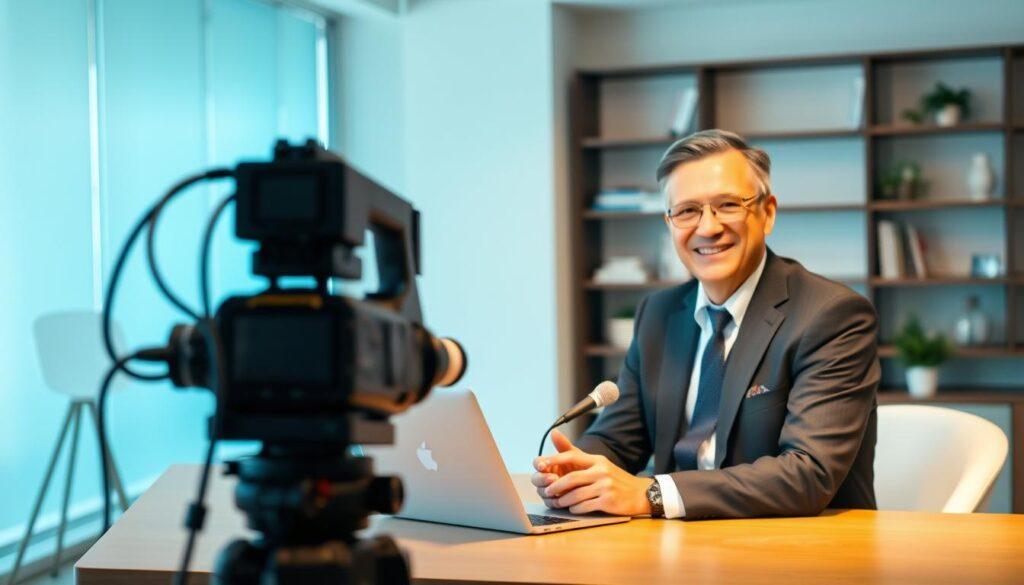
The setup is key for capturing this dynamic. A two-shot shows both you and the interviewer, making it a conversation. The reaction shot adds depth, showing your interviewer’s engagement.
Finding the right interviewer is critical. They should listen and follow up, creating a safe space for authenticity. You need someone who is curious and empathetic, making the viewer feel like they’re eavesdropping on something interesting.
Choosing your interview style should match your brand and the platform. It’s about being true to yourself and your audience.
| Format Style | Primary Goal | Question Type | Best For | Potential Pitfall |
|---|---|---|---|---|
| Journalistic Interview | Fact-finding & Credibility | Direct, prepared | Establishing authority on complex topics | Can feel stiff or overly rehearsed |
| Conversational Dialogue | Relationship Building | Open-ended, follow-up heavy | Showing personality, empathy, and thought process | May lack structure or focus without a strong host |
| Rapid-Fire Q&A | Energy & Engagement | Short, provocative, quick-turn | Social media snippets and brand awareness | Can sacrifice depth for the sake of speed |
The conversational dialogue is perfect for modern entrepreneurs. It’s where your expertise meets your humanity. You’re not just listing achievements; you’re explaining the “why” behind them.
Preparing for this style of video headshots content is unique. You must prepare thoroughly to appear unprepared. Know your core messages, but trust the flow. A great interviewer will guide you back if you wander, but they’ll also chase the interesting detour.
This format transforms you from a talking head into a thinking, feeling professional. It showcases not just what you know, but how you think. In a digital world saturated with static claims, that’s your undeniable edge. The proof isn’t just in your answer—it’s in the conversation itself.
Behind-the-Scenes Content: Authentic Video That Humanizes Professional Brand
Forget the flawless facade. Today’s most compelling brand stories are written in the unscripted moments between takes. In a world saturated with polished corporate speak, the radical act is showing the actual work. This isn’t about posting shaky, poorly lit phone clips. It’s about the strategic curation of your process.
Think of it as the video equivalent of a writer’s marked-up manuscript. It’s the B-roll of your professional life, intentionally captured. This content builds a bridge of relatability no mission statement can cross. Authenticity, deployed correctly, is a trust-building accelerant.
So, what does this look like in practice? It’s the quiet focus before a big client call. It’s the chaotic energy of a whiteboard brainstorming session, half-formed ideas swirling. It’s the simple ritual of morning coffee while reviewing the day’s goals. These glimpses don’t show perfection. They show progress.
Elon Musk demystifies the genius of SpaceX by walking a factory floor. Marie Forleo builds a tribe by sharing the real business struggles behind her success. They aren’t just selling a product or service. They’re humanizing a brand. Your professional brand videos gain immense power from this same vulnerability.
| Content Type | Strategic Intent | Platform Sweet Spot |
|---|---|---|
| Process Glimpse (e.g., Workspace Tour) | Demystify your craft, showcase tools and environment. | Instagram Stories, LinkedIn Carousel |
| Idea Generation (e.g., Whiteboard Session) | Reveal creative problem-solving, invite audience into your thinking. | YouTube Shorts, TikTok |
| Problem-Solving (e.g., “Debugging” a client issue) | Build credibility by showing expertise under pressure. | LinkedIn Video, Website Blog |
| Pre-Event Prep (e.g., Before a keynote) | Create anticipation and showcase dedication. | Instagram Reels, Twitter/Threads |
The key is intentional imperfection. Frame the shot. Use decent audio. But let the content be real. This brand video content works because it bypasses the cynicism we all have towards advertising. We connect with people, not personas.
Integrate these BTS moments as supplementary clips to your main video headshots. They provide context and depth. They are the “how” and “why” behind the “who” you present in your primary footage. This isn’t just “keeping it real.” It’s the most sophisticated brand-building play you have. Your audience doesn’t want a statue. They want a guide they can relate to.
Production Timeline: Planning and Executing Professional Video Headshot Sessions
Think a professional video shoot needs a week of your time? Think again. We’ll show you how to plan it like a pro.
For today’s entrepreneur, making video content should be easy and quick. We break it into three parts: planning, shooting, and editing. It’s all about making your brand look good, not about wasting time.
The Strategic Week (Pre-Production)
This is where the real work starts, before you even film. We don’t waste your time. In just a few hours, we plan your script, wardrobe, and location. We scout places online or quickly visit them.
This way, you can focus on your performance, not worrying about the details.
The Surgical Strike (Production Day)
No need for long, grueling shoots. A professional video session is quick and precise. We set up everything beforehand, so you can just focus on being your best self.
Now, the raw footage becomes your story. This isn’t a time to wait. A skilled editor works their magic, making sure everything looks and sounds perfect.
You’ll get a first cut to review. Your feedback makes it even better. The idea that editing takes forever? Not true. Good planning makes it fast.
| Phase | Key Activities | Realistic Time Commitment |
|---|---|---|
| Pre-Production | Script finalization, wardrobe selection, location scouting, technical prep. | 3-5 hours (spread over 1 week) |
| Production | Setup, filming, multiple takes and angles, breakdown. | 2-4 hours (on shoot day) |
| Post-Production | Editing, color grading, audio sweetening, client review, final delivery. | 5-7 business days |
| Total Project Timeline | From kickoff to final video asset delivery | 10-14 days |
The end result? Great entrepreneur video content on time. No lost weekends or extra costs. Your brand story is a smooth operation, not a crisis.
Budget Considerations: Video Production Costs vs Photography Investment Analysis
Looking at the cost of photography versus video production is like comparing a simple photo to a big-budget movie. The costs and benefits are vastly different. Photography is a one-time buy, while video is a long-term investment.
Think of a photography session as buying a great photo. But a business video photography package is like investing in a powerful tool. This tool can be used in many ways for years, boosting your online presence.
So, where does the money go? Video production has more specific costs:
- Crew: Director, cinematographer, sound engineer.
- Equipment: Cinema cameras, lighting rigs, audio kits.
- Location: Studio rental or location fees.
- Post-Production: Editing, color grading, motion graphics.
The return on investment (ROI) for video is impressive. A single video isn’t just one asset. It’s the start of a content machine.
One video can become many things: a homepage video, social media clips, podcast intros, and more. You’re not just buying a video. You’re investing in a year’s worth of content. The cost spreads out over time.
Is it worth it? Often yes, when you consider the value of dynamic content. A bad photo is a mistake, but missing out on video is a strategic error. Video engages more, works harder, and converts better.
The real question isn’t just about the cost of business video photography versus photography. It’s about the value of a dynamic asset versus a static one. Spend your budget on what will serve you for the next two years.
Performance Metrics: Measuring Engagement and ROI for Video vs Static Content
You launched your personal brand video into the digital ether. Now what? Feelings are nice, but metrics are truth.
Forget view counts. They are the participation trophies of analytics. Real measurement starts with watch time. Did your audience stay past the first three seconds? A high drop-off rate is a silent scream for better hooks.
Engagement is the heartbeat of your content. A static image might earn a polite like. But a dynamic personal brand video prompts shares, comments, and saves. This is social proof in motion.
The ultimate question is ROI. Did your video drive action? Use trackable links to monitor click-through rates to your website or Calendly. Platforms like LinkedIn Analytics and YouTube Studio provide the native data. Connect views to lead forms and eventual sales.
Conduct a simple A/B test. Run your video thumbnail against your professional headshot in an ad campaign. Which generates more profile visits or inquiries? The data delivers a verdict.
This final step turns creative work into business intelligence. It proves the thesis with cold, hard numbers. Your investment in a personal brand video pays off when the analytics show a clear path from view to value.