A passport photo gives you remarkably little room to control how you look.
You cannot choose an interesting background.
You cannot turn toward your more flattering side.
You cannot hide behind sunglasses.
You cannot use a beauty filter afterward.
And according to current U.S. Department of State guidance, you should not digitally retouch, reshape or enhance the photograph—including with artificial intelligence.
That leaves one surprisingly important variable under your control:
what you wear.
For a U.S. passport photo, the Department of State requires a recent color photograph against a plain white or off-white background, with your head centered, your face directed toward the camera and your features clearly visible. Uniforms, clothing resembling uniforms and camouflage are prohibited. Ordinary everyday clothing, however, leaves plenty of room for choices that can make the photograph look cleaner and more flattering without interfering with identification requirements. U.S. passport photo requirements
The best passport-photo outfit is therefore not necessarily your most fashionable outfit.
It is clothing that creates enough contrast around your face, fits cleanly within a very tight crop and does not compete with the one thing the photograph is designed to show clearly:
you.
Start With The White Background
Before deciding what looks flattering, remember what will be behind you.
For U.S. passports, the background must be plain white or off-white, without shadows, textures, lines or objects. The Department of State also recommends standing several feet away from the background to reduce shadows.
That immediately affects clothing.
A white shirt against a white wall can visually merge with the background, particularly when the photograph is small.
That does not mean white clothing is automatically prohibited. The State Department’s current clothing rules do not establish a general ban on white shirts.
But there is a difference between something being permitted and something photographing particularly well.
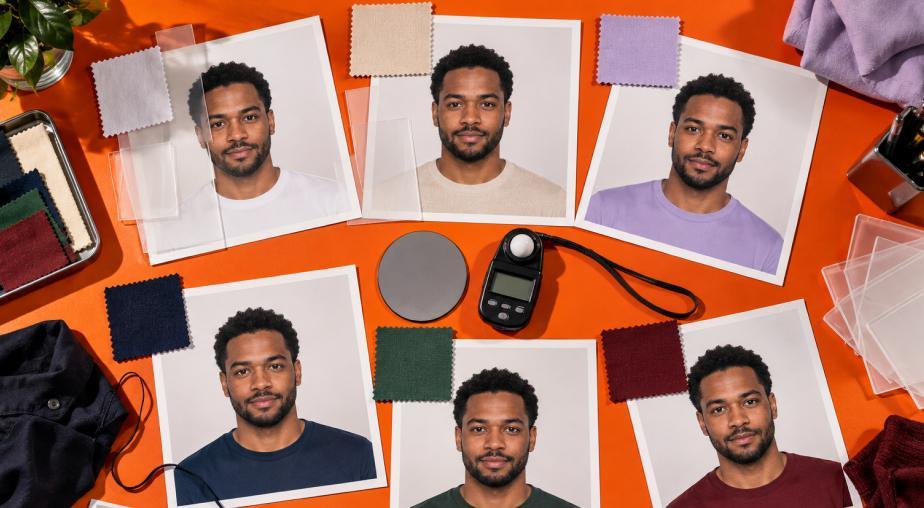
If your goal is to create a clear separation between your head, shoulders and background, a garment noticeably darker than white or off-white will usually provide more visible contrast.
Navy, charcoal, dark green, burgundy, medium blue and many muted colors can accomplish that without overwhelming the face.
Think about the passport photograph as a composition.
The background is already fixed.
Your clothing is one of the few remaining elements capable of defining your silhouette.
Darker Clothing Often Creates A Cleaner Outline
A passport photograph is tiny.
The printed U.S. version measures 2 by 2 inches, or 51 by 51 millimeters. The head must measure between approximately 1 and 1 3/8 inches, or 25 to 35 millimeters, from the bottom of the chin to the top of the head.
That means relatively little clothing is visible.
You are not really choosing an outfit for a full-body photograph.
You are choosing what appears immediately beneath your neck and around your shoulders.
This is why simple darker tops can work particularly well.
A navy crewneck, charcoal blouse, dark-blue shirt or muted green top can establish a clear lower boundary against the light background while allowing the face to remain the brightest and most visually informative area.
Black can also provide strong contrast, although it is not the only solution.
You do not need to dress as though you are attending a formal event.
The objective is separation, not seriousness.
Your Neckline Matters More Than Most Of Your Outfit
Because passport photographs are cropped tightly, your shoes, trousers and much of your shirt may never appear.
The neckline does.
A clean crewneck, modest V-neck, open collar or simple blouse neckline can frame the face without becoming visually dominant.
Extremely high collars can occupy more of the limited visible space around the neck.
Large scarves create another issue: the State Department specifically shows scarves covering portions of the face as unacceptable. Your full face needs to remain visible.
A very low neckline can create the opposite visual problem.
Because only the upper portion of your body appears, an unusually low-cut top may become almost invisible in the final crop, creating the visual impression that there is very little clothing beneath the face.
The safest photographic choice is usually somewhere between those extremes.
Choose a neckline that remains clearly visible within a head-and-shoulders composition.
Solid Colors Make The Photograph Easier To Read
Passport regulations do not require everyone to wear solid colors.
But visually, simple clothing has advantages.
A passport photograph already contains very little information.
Your face occupies much of the frame.
A strong pattern immediately beneath it can compete for attention, especially once the image is reduced to passport size.
Large stripes, high-contrast checks, complicated graphics and extremely busy prints can become disproportionately noticeable.
Small patterns can create another photographic problem: depending on the camera, resolution and print process, tightly repeating lines may produce distracting visual interference.
None of this means patterns are inherently unacceptable.
It means they usually offer little benefit in an identification photograph.
A solid or visually quiet garment allows the face to remain dominant.
You Do Not Need To Wear Black
Passport-photo advice sometimes becomes unnecessarily rigid.
Wear black.
Never wear white.
Always wear a collared shirt.
Avoid every bright color.
Those are not the current U.S. passport rules.
The State Department focuses instead on whether your face is visible, whether the background and lighting are correct, whether prohibited clothing is present and whether the image represents your current natural appearance.
That leaves considerable freedom.
Someone who rarely wears black does not need to transform themselves for the photograph.
A medium blue, burgundy, forest green, brown, muted purple or another familiar color may work just as well.
The useful question is not:
“What color makes everyone look best?”
It is:
“Does this color separate me from the background while keeping attention on my face?”
Think About Contrast With Your Hair Too
Background contrast is only part of the composition.
Clothing also interacts visually with hair.
Someone with very dark hair wearing a very dark top can create a strong continuous shape around the face. That may look clean and intentional.
Someone with very light hair might prefer a medium or darker garment to create more structure below the face.
But these are aesthetic considerations, not passport requirements.
There is no universal clothing color that flatters every combination of skin tone, hair color and lighting.
The practical approach is to test.
Stand in front of the same white or off-white background you plan to use.
Take a quick unedited photograph wearing two or three possible tops.
Reduce the images on your screen until they are approximately passport-photo size.
The differences often become much easier to see.
Wear Something That Still Looks Like You
There is another reason not to over-style the photograph.
A passport is an identification document.
The State Department requires the image to have been taken within the previous six months so it reflects your current appearance.
Your clothing does not need to duplicate what you wear every day, but there is little reason to create an artificial persona for the photograph.
If you normally dress casually, you do not need a suit simply because the photograph will appear in an official document.
If you normally wear professional clothing, a clean shirt or blouse may feel more natural.
A passport photograph is not a corporate headshot.
There is no requirement to look executive, fashionable or formal.
The photograph needs to identify you clearly.
Looking polished and looking recognizable can coexist.
Avoid Uniforms And Camouflage
Here the guidance becomes much less flexible.
The Department of State says you cannot wear a uniform, clothing that looks like a uniform or camouflage clothing in a U.S. passport photograph.
That makes certain wardrobe choices unsuitable regardless of how flattering they might otherwise appear.
If you are having your photograph taken immediately before or after work, check what you are wearing.
An employee badge or lanyard should also be removed for the photograph; the Department specifically calls this out in its digital-photo guidance.
The easiest approach is ordinary civilian clothing with no occupational context that could complicate the image.
Remove Your Glasses Before Thinking About The Outfit
Glasses can be such a strong part of someone’s everyday appearance that removing them may make the face feel unfamiliar.
For U.S. passport photographs, however, eyeglasses must normally be removed.
The State Department allows an exception when someone cannot remove glasses for medical reasons, in which case supporting medical documentation is required.
Do not place the glasses on top of your head for the photograph either.
From a visual perspective, removing glasses changes more than compliance.
It exposes the eyebrows and eye area differently.
Someone accustomed to choosing clothing that works with distinctive frames may discover that a different neckline or color looks better once the glasses disappear.
If you always wear glasses, take them off before evaluating your passport-photo outfit in the mirror or test photograph.
That way you are judging the appearance that will actually be photographed.
Jewelry Is Usually Fine When It Does Not Hide Your Face
You do not have to remove every accessory.
Current State Department guidance says jewelry and facial piercings may remain as long as they do not hide the face.
That provides considerable flexibility.
Simple earrings, necklaces and facial piercings do not automatically create a problem.
But the same visual principle that applies to clothing applies to jewelry:
the passport photograph is small.
A very large reflective accessory can become surprisingly prominent.
If your goal is a clean photograph, subtle jewelry may integrate more naturally into the composition.
That is an aesthetic recommendation, not an official requirement.
If a piece of jewelry is part of how you normally present yourself and it does not obscure your face, there is no general need to erase that part of your appearance.
Head Coverings Have Specific Exceptions
Ordinarily, hats and head coverings must be removed.
There are exceptions for religious and medical reasons.
For a religious head covering, the State Department requires appropriate documentation stating that it is religious attire worn daily in public. Medical head coverings similarly require documentation.
When a permitted head covering is worn, the entire face must remain visible, there must be no shadows blocking facial features, and current passport guidance says the covering should be one color without patterns or small holes.
This is an area where official requirements matter more than general styling advice.
The objective should be a clean, unobstructed face rather than trying to manipulate the head covering solely for photographic effect.
Hair Is Part Of The Composition Too
The State Department allows hair to extend beyond the edges of the photograph as long as the entire head is shown appropriately, but hair cannot block portions of the face or obscure the eyes.
That leaves plenty of styling freedom.
You do not have to pull your hair back simply because you are taking a passport photograph.
But look carefully at what happens around the eyes, cheeks and jaw.
Hair falling forward may create asymmetry or shadows that you do not notice in a mirror.
Very voluminous hair may also change how the photograph needs to be framed.
The goal is not to make your hairstyle smaller.
It is to make sure your facial features remain unobstructed and the complete head can be properly accommodated within the required composition.
The Best Shirt Cannot Fix Bad Lighting
Wardrobe advice has limits.
Someone can choose an ideal color, neckline and accessory combination and still dislike the resulting photograph because the lighting is poor.
The Department of State requires uniform lighting across the face and warns against both overexposure and underexposure. Strong overhead lighting or illumination positioned too far to one side can create unacceptable shadows.
Its guidance for online passport renewal specifically recommends taking the photograph in a well-lit area with natural lighting and avoiding shadows on both the face and background.
Good lighting also helps clothing look more accurate.
A navy shirt should not become a featureless black mass.
A burgundy top should not acquire an unnatural color cast.
More importantly, your skin tone should reproduce accurately.
If you are taking the photograph yourself, solve the lighting before trying to solve your appearance with clothing.
Your Expression Changes How The Clothing Feels
A formal outfit combined with a tense expression can make a passport photograph appear more severe than intended.
A casual top combined with relaxed posture may feel considerably more natural.
Current State Department passport guidance allows a neutral expression or a natural closed-mouth smile, provided the eyes remain open and visible. The head should face directly forward without tilting, and the shoulders should remain square to the camera.
You therefore have a little more expressive freedom than the stereotype of the completely emotionless passport photograph suggests.
Before the picture is taken, relax your shoulders.
Release unnecessary tension in the jaw.
Look directly toward the lens rather than at your own face on a screen.
If you smile, keep it subtle and your mouth closed.
The clothes frame the portrait.
Your expression still determines much of how the portrait feels.
Do Not Plan To Fix Your Outfit Or Appearance Later
Modern photography makes it tempting to treat every imperfection as something that can be corrected after the shutter is pressed.
Passport photography is different.
The State Department requires the original, unedited photograph without filters or digital changes. It specifically warns applicants not to use software or artificial intelligence to alter the background or appearance.
That means you should not plan to digitally remove a distracting necklace.
Do not smooth wrinkled clothing afterward.
Do not recolor a shirt.
Do not replace the background because your clothing did not contrast properly.
Do not reshape hair.
Do not retouch your face.
If something looks wrong, change it physically and take another photograph.
That makes preparation unusually valuable.
Take A Test Photo In The Actual Outfit
The mirror is not the best way to decide.
A passport photograph is flattened into a small square with a white background and relatively even lighting.
An outfit that looks excellent from head to toe may behave very differently when only the shoulders and neckline survive the crop.
Before your final photograph, make a test image under approximately the same conditions.
Look for several things.
Can you clearly distinguish your shoulders from the background?
Does the neckline remain visible?
Is a pattern unexpectedly distracting?
Does jewelry dominate the small frame?
Is hair covering part of the face?
Does the color reproduce naturally under the lighting?
Then make adjustments before the official photograph.
No digital enhancement is necessary.
The camera itself can tell you whether the clothing works.
A Simple Passport-Photo Outfit Usually Works Best
For most people, there is no need to buy anything specifically for a passport photograph.
Start with clothing you already own.
Choose a clean top that fits comfortably around the shoulders and neckline.
Favor a color that provides visible contrast with white or off-white.
Avoid uniforms and camouflage.
Remove glasses, hats and prohibited accessories.
Keep anything around the neck from blocking the face.
Then pay attention to lighting, posture, hair and expression.
Those elements will affect the finished portrait far more than whether your shirt follows a particular fashion rule.
The most useful passport-photo outfit is therefore not necessarily the one that attracts the most compliments in everyday life.
It is the one that almost disappears as a subject.
Your shoulders remain distinct from the background.
Your neckline frames rather than competes with your face.
Nothing obstructs the features needed for identification.
And when you eventually open the passport, your attention goes first to the person in the photograph rather than to what that person happened to be wearing.