New York has no shortage of ways to make a portrait.
A phone can capture hundreds of images in minutes. A professional photographer can tether a camera to a computer and review every frame immediately. AI-powered editing tools can remove distractions, adjust expressions and transform backgrounds after the shutter has been pressed.
Yet at the International Center of Photography on Manhattan’s Lower East Side, one of the current attractions works very differently.
ICP has installed a restored Model 11 analog photo booth at its home at 84 Ludlow Street, where visitors can sit down, receive four flashes and wait approximately four to five minutes for a strip of chemically developed photographs to emerge. The booth costs $7, and ICP says no museum ticket is required to use it. ICP’s analog photo booth dates from the Model 11 manufacturing period of 1955 to 1964.
Outside, ICP has been taking another form of instant portraiture onto the streets.
Its 2026 Lower East Side Late Nights have included Fujifilm Instax street-portrait pop-ups at Ludlow and Broome Streets. Photographers in the series have included Patience Ojionuka, Abigail Montes, Jutharat “Poupay” Pinyodoonyachet and Justin J Wee, with Landon Nordeman scheduled for September 24.
These are not identical photographic processes. Instax and a mid-century chemical photo booth work differently.
But culturally they share something that has become increasingly unusual:
the portrait quickly becomes a physical object.
That may help explain why instant portraits feel surprisingly relevant in a period when most photographs never leave a screen.
ICP Is Putting Physical Portrait-Making Back Into The Experience
ICP’s current programming does not treat analog photography only as something historical to display behind glass.
Visitors can actually make photographs.
The restored Model 11 occupies ICP’s free ground-floor space. The machine exposes photographic paper directly and then processes it through chemical and rinse tanks inside the booth. That is why, according to ICP, the completed strip arrives wet and needs additional time to dry.
Meanwhile, the institution’s Lower East Side Late Nights have taken instant portrait-making outdoors.
The ICP Late Nights program combines extended museum hours with the analog booth and Fujifilm Instax portrait sessions on selected Thursdays. On September 10, Brooklyn-based interdisciplinary artist Justin J Wee photographed the public; on September 24, the scheduled photographer is Landon Nordeman.
Nordeman’s involvement is particularly interesting because his professional work has appeared in publications including Vanity Fair, The New Yorker, New York Magazine, Vogue and The New York Times. ICP says he has spent two decades photographing assignments ranging from fashion week to political conventions.
Putting that experience into a street-portrait setting changes the relationship between photographer, subject and final image.
The session is no longer simply about producing a digital file.
It is also about the event of being photographed.
Instant Photography Changes The Number Of Decisions You Can Make
Digital photography changed portrait-making partly by removing scarcity.
Taking another frame costs practically nothing.
Someone dislikes their expression?
Take another.
They blinked?
Take another.
Hair moved?
Take another.
The smile feels awkward?
Take twenty more.
That flexibility is enormously useful. Professional portrait photographers can work through subtle changes in posture and expression until they find the strongest image.
But abundance also changes behavior.
When people know there can be dozens—or hundreds—of attempts, each individual exposure becomes less final.
Instant photography introduces a different rhythm.
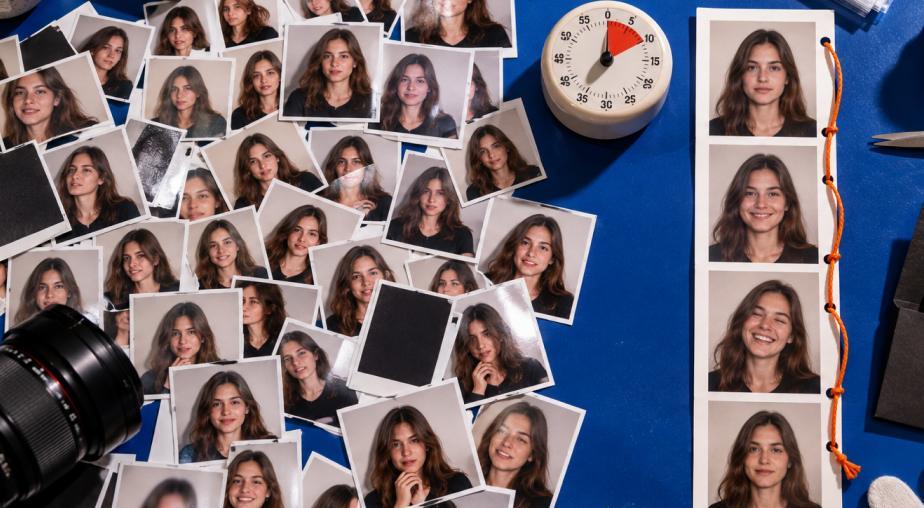
ICP’s Model 11 provides four photographs. The machine flashes four times. There is no enormous gallery of alternatives waiting afterward.
Four frames are enough to experiment.
They are not enough to endlessly optimize yourself.
A Photo Booth Removes The Photographer From The Room
A conventional portrait session contains a social relationship.
The photographer looks at you.
They may tell you where to stand.
They may ask you to lower your chin.
They can suggest an expression.
They decide when to press the shutter.
That interaction can help someone relax, but it can also increase self-consciousness.
A traditional photo booth changes the equation.
You close the curtain.
The photographer disappears.
The camera remains.
ICP’s Model 11 gives the sitter practical control over a few variables. Visitors can select a white or light-blue curtain and adjust the height of the stool before starting the sequence. Once payment is made, however, the process moves forward through four flashes.
That limited environment creates an unusual form of self-portraiture.
You are performing for a camera, but not directly for another person standing behind it.
The resulting expression may be playful, serious, awkward or unexpectedly natural.
There is less external direction.
The sitter has to decide what to do with their own face.
Four Frames Can Become A Tiny Story
A photo strip also does something that a single profile picture cannot.
It creates a sequence.
Frame one can be careful.
Frame two can loosen.
Frame three can become ridiculous.
Frame four can reveal the reaction to frame three.
The photographs acquire meaning from their relationship with one another.
ICP itself encourages visitors to try a different expression for each of the Model 11’s four exposures.
That transforms a basic identification-style composition into something closer to a miniature performance.
The background remains almost identical.
The camera does not move.
The framing changes very little.
The variable is the person.
That simplicity can make small changes in expression surprisingly noticeable.
A raised eyebrow matters.
A head tilt matters.
Two people moving closer together matters.
A smile disappearing between frames matters.
The restrictions become part of the creativity.
The Wait Is Part Of The Photograph
Modern phone photography has almost eliminated the interval between taking a photograph and seeing it.
Tap the shutter.
Look immediately.
Zoom into the face.
Decide whether you like it.
Retake.
An analog booth interrupts that feedback loop.
At ICP, the Model 11 strip takes approximately four to five minutes to emerge. Because it has passed through chemical processing and water-rinse tanks, it arrives wet and needs to be handled carefully before fully drying.
Four or five minutes is not a long time.
In contemporary photography, however, it is significant.
You cannot inspect frame one before deciding what to do in frame two.
You cannot see that your smile looked strange and instantly correct it.
You have already made the pictures.
That delay separates performance from judgment.
For people accustomed to checking themselves after every phone photograph, that can feel remarkably different.
The Imperfect Photograph Has Fewer Opportunities To Disappear
Digital photography makes rejection effortless.
A portrait can vanish because of a blink, an unusual expression or a small detail someone dislikes about their appearance.
Sometimes that is useful. Nobody needs to keep every photograph.
But constant selection can also create a highly controlled personal image.
We tend to publish photographs that satisfy our preferences about how we should look.
An instant print complicates that process because the unwanted frame may remain physically attached to the one you love.
The photo-booth strip might contain three good expressions and one strange one.
That strange photograph is still part of the object.
Over time, it might even become the most memorable frame.
Instant photography therefore gives imperfection a physical persistence that digital galleries rarely require.
A Physical Portrait Cannot Be Swiped Away
The finished object is another major difference.
Most contemporary portraits become files.
They enter a camera roll alongside screenshots, receipts, memes, food photographs, documents and thousands of other images.
An instant portrait enters the world as an object.
You can put it in a wallet.
Pin it to a wall.
Slide it into a mirror frame.
Give it to someone.
Write a date on the back.
Leave it inside a book and discover it years later.
The physical photograph occupies space.
That does not make it artistically superior to a digital photograph. Digital files offer enormous advantages in accessibility, reproduction, editing and distribution.
The experiences are simply different.
One emphasizes circulation.
The other can emphasize possession.
Street Portraits Add A Stranger Back Into The Equation
ICP’s Fujifilm Instax program creates another variation on instant portraiture.
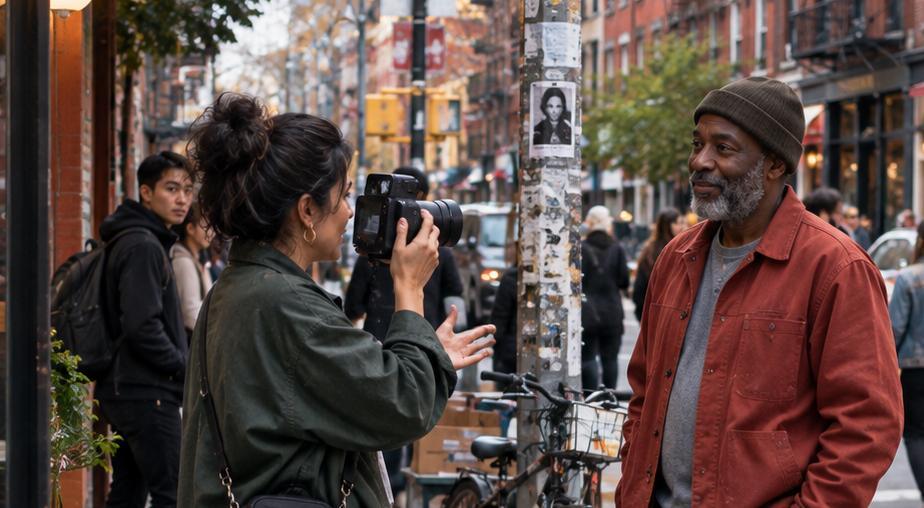
Instead of sitting privately behind a photo-booth curtain, participants encounter an actual photographer outdoors at Ludlow and Broome Streets.
The 2026 series has deliberately rotated photographers rather than standardizing the portrait experience around one operator.
That matters.
Photographers do not simply operate cameras.
They notice different things.
They interact with subjects differently.
They choose different moments.
Jutharat “Poupay” Pinyodoonyachet, who participated on August 27, is a New York-based photographer originally from Bangkok whose work is associated with direct flash, vivid color and chance encounters in city life.
Justin J Wee, who photographed participants on September 10, works across lens-based media, culinary arts and performance and has produced commissioned work for organizations and publications including Apple, A24, The New York Times, TIME and Vanity Fair.
Nordeman brings another visual background to the September 24 session.
The physical format may be consistent, but the person behind the camera changes.
That reminds us that instant does not necessarily mean anonymous.
Instant Portraits Fit The Lower East Side Particularly Well
Location matters here too.
ICP is at 84 Ludlow Street, in Manhattan’s Lower East Side. Its Instax sessions take place nearby at Ludlow and Broome.
This is not a controlled photography convention separated from everyday city life.
People can encounter portrait-making while moving through a neighborhood.
That gives the program some of the unpredictability associated with street photography while making the portrait itself collaborative.
A person agrees to stand for the camera.
The photographer gets only a limited interaction.
The environment remains active around them.
Then the participant leaves with a physical photograph.
The process turns photography into a small public exchange.
The Model 11 Connects Today’s Portraits With An Older Photographic Habit
ICP says its Model 11 comes from a manufacturing period spanning 1955 through 1964.
That makes the machine itself part of photographic history.
Photo booths helped make portrait photography affordable, spontaneous and accessible in public places long before front-facing smartphone cameras existed. ICP describes its restored machine as continuing to produce original chemical photographs through the same fundamental process associated with twentieth-century booths.
The current appeal therefore contains an interesting contradiction.
The experience feels novel partly because it is old.
Someone raised with smartphone photography may find four fixed exposures and a several-minute wait unusually restrictive.
For an earlier generation, those limitations were ordinary.
Technology has changed so thoroughly that an old constraint can return as a creative feature.
Instant Does Not Mean The Same Thing As Analog
It is worth keeping the terminology precise.
ICP’s Model 11 and the Fujifilm Instax portrait pop-ups belong to the same broader conversation about physical, near-immediate photographs, but they are not the same technology.
The Model 11 exposes photographic paper and processes the strip through chemistry inside the machine.
Instax is Fujifilm’s instant-photography system.
Both can give the subject a physical photograph quickly.
But collapsing every physical process into the word “analog” hides meaningful differences in how the photographs are produced.
For photographers, those differences matter.
For many sitters, however, the most noticeable distinction may simply be what happens at the end:
instead of receiving another image that disappears into a phone, they receive something they can hold.
Instant Portraiture Makes Photography An Event Again
Photography has become so integrated into everyday life that taking a picture often barely registers as an event.
People photograph lunch.
Parking spaces.
Receipts.
Pets.
Screens.
Friends.
The process can be almost unconscious.
A photo booth reintroduces ceremony.
You enter.
You adjust the seat.
You close the curtain.
You pay.
The flashes begin.
Then you wait.
A street portrait creates its own ritual.
You stop.
You meet a photographer.
You decide how to stand.
Someone looks at you carefully enough to make a photograph.
Then the encounter ends.
Those steps make the act more noticeable.
And when an activity becomes noticeable, people may remember more than the final image.
They remember making it.
There Is Still Room For Photographs That Cannot Be Perfected Forever
The return of instant portraits does not mean digital photography has failed.
Nor does it mean photographers should abandon smartphones, mirrorless cameras or editing software.
Instant portraiture offers something complementary.
It places limits around the photographic decision.
There are fewer frames.
There is less time.
There may be no opportunity to examine every pore before choosing another pose.
The image becomes physical quickly.
The subject has to tolerate some uncertainty.
ICP’s current Lower East Side programming makes those qualities visible by putting a restored mid-century photo booth, contemporary Instax photography and working photographers into the same cultural space.
The next Fujifilm Instax portrait session with Landon Nordeman is scheduled for September 24, 2026, from 6 to 8 p.m., while the Model 11 remains available on ICP’s free first floor.
In a culture where a portrait can be captured, reviewed, deleted, retaken, filtered and reshaped before anyone else sees it, that physical immediacy feels distinctive.
The appeal may not really be nostalgia for old cameras.
It may be nostalgia for something photography increasingly allows us to avoid:
making a picture, accepting the moment and seeing what comes out.